

Secure. Certified. Compliant.

Electronics Recycling for Businesses in Washington, Oregon, and Idaho


Responsibly retire outdated computers, servers, monitors, storage devices, networking equipment, and other business electronics with CTL.

Why Businesses Choose CTL for Electronics Recycling

CTL provides secure equipment pickup, documented chain of custody, asset tracking, certified data wiping and destruction services, responsible recycling, and potential value recovery through one regional ITAD partner.

Our certified IT asset disposition and electronics recycling services help protect sensitive data, support regulatory compliance, document final disposition, and recover value from reusable technology.

Pacific Northwest Service

Responsive regional support throughout Washington, Oregon, and Idaho.

Certified Data Security

Documented data protection with R2v3 data sanitization and NAID AAA data destruction.

Responsible Value Recovery

Reuse, resale, and recycling options that reduce risk and recover value.

Recycle Your Business Electronics Without the Risk

Retired electronics may contain confidential business information, employee records, customer data, financial information, passwords, and proprietary files. Deleting files or performing a factory reset may not securely sanitize a device, while improper disposal can create environmental, security, and compliance liabiity exposure.

CTL provides a certified and documented process for collecting, tracking, sanitizing, destroying, reusing, remarketing, and recycling retired business technology for companies, schools, government agencies, healthcare organizations, nonprofits, manufacturers, retailers, and other organizations.

Support Your Electronics Recycling Compliance

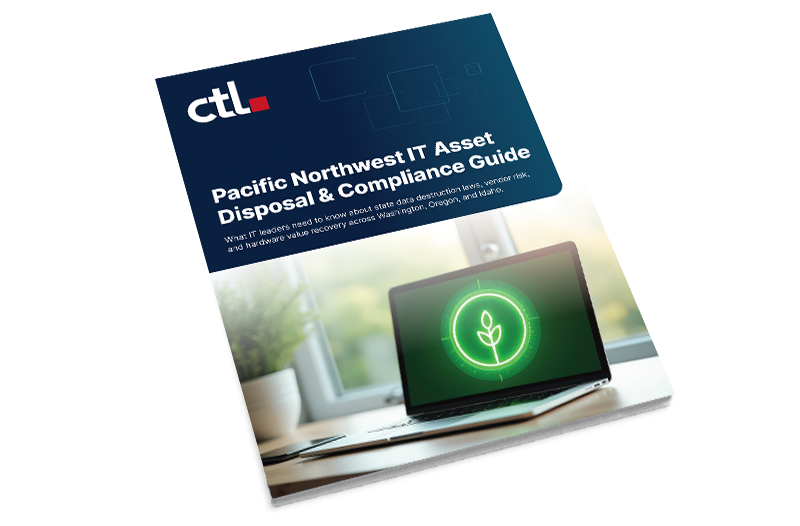
Electronics recycling requirements vary by state, equipment type, industry, and data sensitivity. CTL helps organizations support compliance through certified processes, secure chain of custody, and documented disposition.

Pacific Northwest Commercial E-Waste & Compliance Matrix

State

Governing Law / Statute

Enterprise Eligibility & Restrictions

Required Action for Commercial Businesses

Washington WA Electronic Product Recycling Law (RCW Title 70A.500 / Ch. 70.95N) Excludes businesses with 50 employees from state-funded E-Cycle WA drop-offs. (Only households, non-profits, and small businesses under 50 staff qualify). Medium & large businesses must arrange private, fully documented disposal with a certified partner (e.g., CTL) to maintain a documented chain of custody and pass Department of Ecology audits.
Oregon Landfill Disposal Ban & HB 3220 (ORS 459A.300–.365) Strict landfill ban. Illegal for all businesses to dispose of computers, monitors, networking gear, or peripherals in standard waste streams. Businesses are 100% responsible for funding and documenting hardware recycling under strict EPRO oversight. Must provide verifiable destruction records to avoid state penalties.
Idaho Hazardous Waste Rules (IDAPA 58.01.05 & Federal RCRA) No state electronics recycling program. Commercial entities bear the full burden of hazardous waste determinations for electronic assets prior to disposal. Companies must ensure circuit boards and displays containing lead, mercury, or cadmium do not leach into soil/water. Requires internal corporate IT policies and certified ITAD handling to avoid federal liability.
Compliance note: CTL services can support an organization’s compliance obligations. Customers remain responsible for determining the laws, contracts, and internal policies applicable to their operations.

Three Certified Layers of Protection

R2v3-Certified Recycling

Documented environmental, health, safety, security, reuse, and downstream recycling controls.

R2v3 Appendix B Data Sanitization

Verified logical data sanitization with traceability, recordkeeping, and quality controls.

NAID AAA Data Destruction

Independently audited staff and facility requirements and procedures for the physical destruction of data-bearing media.

Secure IT Asset Disposition and Value Recovery

Eligible equipment may be evaluated for refurbishment, redeployment, resale, parts recovery, trade-in credit, or revenue sharing before nonviable assets are responsibly recycled. Depending on project scope, CTL can also provide pickup coordination, serialized inventory, chain-of-custody records, sanitization or destruction documentation, and recycling reports.

Electronics and Materials We Accept

CTL processes a broad range of business computers, mobile devices, servers, network equipment, data-bearing media, displays, printers, telecommunications equipment, cables, chargers, and related electronics. Acceptance, fees, and logistics vary by equipment type, quantity, condition, and location.

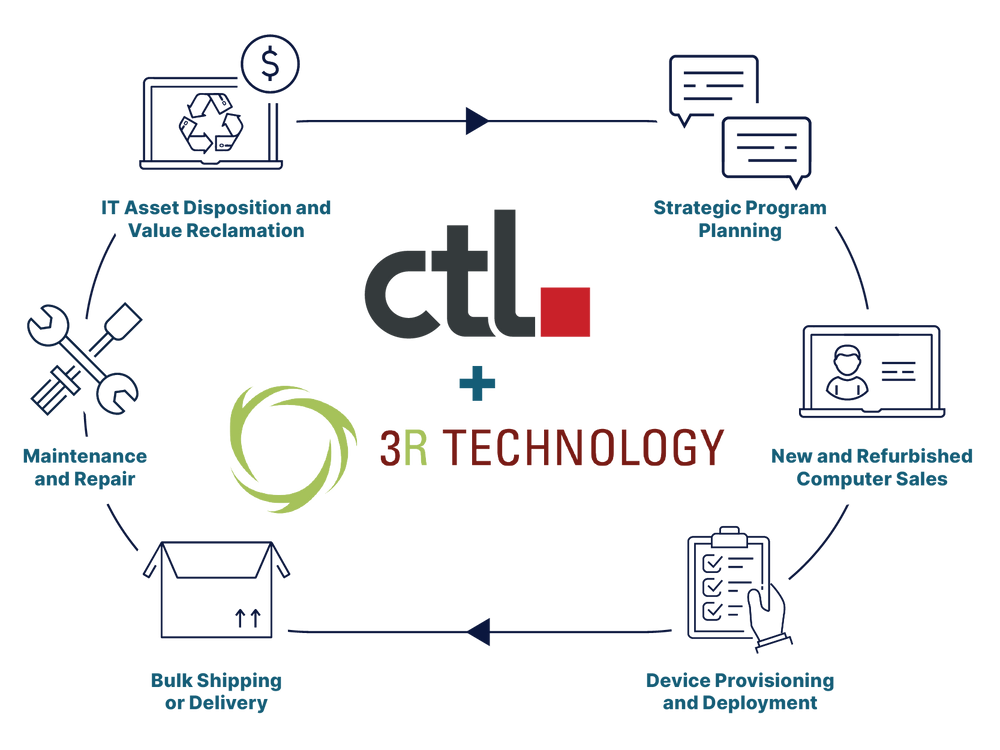
Why Work with CTL for Technology Lifecycle Management?

We maximize the value of your retired IT assets. CTL combines expert logistics, advanced refurbishment systems, and innovative remarketing to ensure you receive the highest possible return.

Recover the most asset value

Our process delivers a positive financial return or net-zero cost on 70% of all customer projects.

Reduce logistical complexities

We handle the logistics of asset disposition, tracking, and production of an audit trail to reduce the burden on IT departments. 

Reduce data security risks

Our R2v3 and NAID AAA certified data sanitization services ensure there is no sensitive data on discarded devices to pose risk of former user data breaches. 

Achieve industry regulatory compliance

Maintain compliance with CTL's documented processes, certifications of data destruction, and environmentally responsible disposal methods.  

Mitigate environmental impact

As a certified B Corp™, CTL properly recycles to avoid pollution and, better yet, refurbishes IT assets for a second life either as whole systems or parts.  

FAQ

A commercial electronics recycling program should cover the full custody and disposition process—not just the final recycling step. CTL can coordinate equipment pickup, transportation, serialized inventory, data sanitization or physical media destruction, refurbishment, value recovery, downstream recycling, and final documentation.

For larger projects, businesses should prepare an asset manifest that identifies the make, model, serial number, asset tag, location, ownership status, and whether each device contains data-bearing media.

There is no single Pacific Northwest rule for commercial electronics disposal.

In Washington, the guide states that businesses with 50 or more employees are excluded from the state-funded E-Cycle Washington collection program and should arrange private, documented commercial recycling.

In Oregon, computers, monitors, and televisions are prohibited from municipal landfill disposal, and the state’s updated framework expands oversight of additional electronics.

In Idaho, businesses may need to perform a hazardous-waste determination before disposing of electronics that contain regulated materials. Businesses operating in more than one state therefore need a process that accounts for each location’s requirements.

Documentation should match the services performed and provide a defensible record of what happened to the equipment.

Depending on the project, CTL may provide:

  • A bill of lading or chain-of-custody transfer record
  • A serialized inventory report
  • Data sanitization results
  • Certificates of Data Destruction
  • Certificates of Recycling
  • Reuse, resale, or value-recovery reporting
  • Weight and material summaries

Businesses should confirm the required reports before pickup, especially when the documentation will support an internal audit, privacy policy, vendor review, or regulatory inquiry.

R2v3 certification applies documented controls to how electronics are received, tracked, evaluated for reuse, processed, recycled, and transferred to downstream vendors.

For a business customer, this means CTL’s electronics recycling operation is independently audited against requirements covering data security, environmental management, worker health and safety, reuse, material recovery, and downstream accountability. It also helps reduce the risk that retired electronics are improperly exported, dumped, or transferred to an unverified processor.

R2v3 Appendix B applies additional requirements to data sanitization processes. These controls include device traceability, security procedures, recordkeeping, verification, quality controls, and documented sanitization outcomes.

This is important for devices that may be refurbished or resold. Rather than destroying a functional device solely because it contains data, Appendix B-certified sanitization can securely erase eligible media while preserving the equipment’s reuse and recovery value.

A factory reset should not be treated as verified business data sanitization.

Devices may still contain recoverable company, employee, customer, financial, health, or authentication data. The appropriate process depends on the media type, encryption status, information sensitivity, and whether the device will be reused.

Before pickup, businesses should also remove devices from Microsoft Autopilot, Apple Business Manager, Google Admin, or other mobile-device-management platforms and disable activation locks. Locked devices can lose significant resale value even after the underlying data has been sanitized.

Physical destruction may be the better option when storage media or the computer is damaged, obsolete, nonfunctional, subject to a destruction-only policy, or contains information that should never be reused.

CTL’s NAID AAA-certified data destruction process can be used for eligible hard drives, solid-state drives, backup tapes, mobile-device storage, and other data-bearing media. Businesses should request serialized reporting that identifies the media, destruction method, and processing date when asset-level audit documentation is required.

NAID AAA certification focuses specifically on secure information destruction operations.

Certification includes independent oversight of areas such as facility security, employee screening, access controls, surveillance, transportation procedures, chain of custody, destruction processes, and documentation. NAID AAA-certified providers are also subject to unannounced audits, giving businesses stronger evidence of vendor due diligence than a company that only claims to be “NAID compliant.”

CTL can coordinate qualifying pickups throughout Washington, Oregon, and Idaho, including bulk equipment removal and multi-location projects.

Before scheduling, businesses should provide:

  • Pickup addresses and access requirements
  • Equipment types and estimated quantities
  • Number of pallets or loose devices
  • Whether packing or palletization is needed
  • Data destruction requirements
  • A preferred project timeline
  • An existing asset manifest, when available

At pickup, the business should verify driver credentials, compare the physical count against the manifest, and retain a signed transfer receipt or bill of lading.

CTL recommends four preparation steps:

  1. Reconcile the inventory: Record serial numbers, asset tags, make, model, location, and whether the equipment is leased or owned.
  2. Remove administrative locks: Unenroll equipment from MDM platforms, disable activation locks, and remove BIOS or firmware passwords.
  3. Secure the staging area: Store equipment in a locked, access-controlled space until pickup.
  4. Document the transfer: Verify the count with the driver and retain a signed chain-of-custody record.

These steps help protect data, prevent missing assets, accelerate processing, and preserve potential resale value.

Yes, when the equipment has sufficient resale or refurbishment value.

Value is generally influenced by:

  • Age and generation
  • Processor, memory, and storage specifications
  • Physical and cosmetic condition
  • Battery health
  • Quantity and model consistency
  • Included chargers and accessories
  • Activation-lock or MDM status
  • Current secondary-market demand

CTL typically issues a check on approximately 70% of ITAD projects where devices are refurbishable. Businesses may also direct eligible proceeds to CTL’s Make IT Count program, where buyback value can support environmental, educational, or community nonprofits.

“Compliant” can be a self-declared marketing claim. Certification means an independent organization has audited the provider’s procedures, facility, personnel controls, records, and operational systems.

We recommend verifying R2v3 certification through the official SERI directory and NAID AAA certification through the official i-SIGMA directory rather than relying solely on website logos. A certified provider also offers stronger documentation for vendor due diligence, audits, insurance reviews, and regulatory inquiries.

CTL’s program is designed for organizations managing business-owned electronics, sensitive data, multiple assets, or formal reporting requirements, including:

  • Corporations and small businesses
  • School districts, colleges, and universities
  • Healthcare organizations
  • Insurance companies
  • Banks and financial-services firms
  • State and local government agencies
  • Manufacturers and retailers
  • Data centers and technology companies
  • Nonprofits and professional-services firms

The service is especially relevant when an organization has a large equipment refresh, a backlog of stored assets, multiple locations, regulated data, or equipment that may still have resale value.

Let's Get Started!